Salon Article - Left and Right (Meaningless)
I hate to link to Salon because, well, you can't read it for free. But today, at least, it merely requires watching the Basic Instinct 2 preview, with I don't view as a burden, but a treat.
But once in awhile, the articles are of interest to me, and today there's one about bloggers writing books - specifically Instapundit and Daily Kos.
The article is typically Salon, pretending to be smarter than it is, but it makes a basic point - which doesn't get followed through - that the Left and Right distinctions are becoming increasingly irrelevant.
Me believe this.
Funke, the other day, forwarded my blog address to a group of people, notating that "he tends to be pretty right-wing, so it may damage our collective liberal-arts left-wing-ish sensibilities."
I still find it absurd to be considered "right wing," maybe it's never having voted for a Republican, maybe it's growing up in a Democrat household, not really going to church, I dunno, those hints just seem to me to be representative of not quite qualifying as "right wing," as Tom Delay or George Bush would define it.
I will admit, however, to being a Hawk, in that I think we should kick our enemies ass. Hard and without mercy. I'm not sure why that qualifies as right wing, but if it does, so be it. I also hate bureaucracy, but again, I'm not sure why that qualifies as right wing, either.
I think the far left, over the past five years or so, decided to compete with the far right with who could be the biggest policital fools in this country. Again, if that makes me right-wing, so be it.
Identifying oneself with a party or a political leaning, is like identifying oneself with a gang or fraternity (Chris Rocks says so, too). I think it's bullshit. I'm not in a gang or frat. People, are, as Chris Rock said, neither right or left, they have beliefs that overlap and sometimes come into conflict with political parties or movements.
I don't trust anyone who places too much loyalty into a political position or political party or a politician in general. I mean, does any one of us actually think a single politician offers the answer to things - George Bush or Paul Wellstone or Jesse the Body Ventura, or Bill Clinton?
I believe the system works better than alternatives. I believe in the Constitution works better than alternatives. I sometimes am a realist and sometimes an idealist. Sometimes right, sometimes left, sometimes wrong. I don't like fools, but am often one myself. I like blogs and humor.
I think we all try to simplify things to understand them. I think we have opinions, but be willing to modify them upon discovering new information. I think we often act surprised when events and people don't conform to our "opinions" or impressions, but such suprises are generally reflective of our own ignorance as much as the surprises themselves....and all this so fucking vague I'm sick of writing it.
Friday, March 31, 2006
Is It Just Me...
Or are the 9/11 families growing just a tad bit annoying. Why does it seem like they are in constant litigation? There are ways to be digified about grief.
I'm growing tired of this resurgent blame game about 9/11, how the 911 operators didn't handle the situation well. I mean, maybe the 911 operators are idiots, I'm willing to believe nearly all phone-call customer service type jobs are not stacked with our best and brightest (don't get me started about my 40 min phone call with SBC Yahoo yesterday) but PLEASE, how would the best of all service operators have handled airplanes being flown into buildings? I don't imagine they were trained for terrorist attacks on huge buildings. And could they have reasonably expected to save additional lives? If so, should we punish people for failing to do so?
I've said it 100 times. While 9/11 COULD have been prevented on many levels - US policy tougher and more brutal with Al Queda, tighter FBI practices, our country was simply not AWARE during the 1990s of the Islamicist threat. The people most worried about it were considered "chicken littles," constantly worried about the sky falling. We didn't imagine some dudes in caves being a threat to the US. We were used to being worried about the Soviet Empire and that had collapsed. Why would we worry about these incompetent nutjobs. I mean, there's been anti-American Islamic terrorists around since the 1980s and they had yet to attack the mainland. The Politically Correct thing to say when the topic of Islamic Terrorists came up was something about Oklahoma City.
It's important for us to accept that tragedy happens and not everything is preventable. That being said, after 9/11, there's no reason to keep up the illusion that Al Queda and Islamicism is not THE major threat to the United States, and will be for the forseeable future.
Fool me once, shame on you. Fool me twice, shame on me.
Or are the 9/11 families growing just a tad bit annoying. Why does it seem like they are in constant litigation? There are ways to be digified about grief.
I'm growing tired of this resurgent blame game about 9/11, how the 911 operators didn't handle the situation well. I mean, maybe the 911 operators are idiots, I'm willing to believe nearly all phone-call customer service type jobs are not stacked with our best and brightest (don't get me started about my 40 min phone call with SBC Yahoo yesterday) but PLEASE, how would the best of all service operators have handled airplanes being flown into buildings? I don't imagine they were trained for terrorist attacks on huge buildings. And could they have reasonably expected to save additional lives? If so, should we punish people for failing to do so?
I've said it 100 times. While 9/11 COULD have been prevented on many levels - US policy tougher and more brutal with Al Queda, tighter FBI practices, our country was simply not AWARE during the 1990s of the Islamicist threat. The people most worried about it were considered "chicken littles," constantly worried about the sky falling. We didn't imagine some dudes in caves being a threat to the US. We were used to being worried about the Soviet Empire and that had collapsed. Why would we worry about these incompetent nutjobs. I mean, there's been anti-American Islamic terrorists around since the 1980s and they had yet to attack the mainland. The Politically Correct thing to say when the topic of Islamic Terrorists came up was something about Oklahoma City.
It's important for us to accept that tragedy happens and not everything is preventable. That being said, after 9/11, there's no reason to keep up the illusion that Al Queda and Islamicism is not THE major threat to the United States, and will be for the forseeable future.
Fool me once, shame on you. Fool me twice, shame on me.
Masa
I've invaded Chuck's "Cheers," becoming Frazier to his Norm. Masa is a nice little restuarant in Echo Park down the street for his house. The last time I went, I was intrigued by the Chicago Style Pizza, but it takes an hour preparation. Last night, Phil and I preordered from home.
As we went in, we identified ourselves as the "guys who ordered the pizza." At the table, we were recognized by the wait staff as the "guys who ordered the pizza." We were asked a few moments before the pizza arrived, "are you guys ready for the pizza?" The pizza chef came out and served us the pizza, noticing Phil's Cubs hat, he asked, "From Chicago?" Phil nodded. He was impressed.
We ate the pizza. I thought it was pretty good. Spinach, mushroom, and sausage. They make their own crust - but then again, I guess everyone does...but it had a bakery, buttery feel/taste. I'm a fan of thin crust pizza, but this thick crust was good. The pizza chef comes out again after Phil and I each enjoyed a piece.
"How is it?"
"Good," I say.
"It's fine," says Phil.
"Fine?"
"Yeah, I'm full."
"You're full? Is that what you would say to a musician who just did a song..." he stopped. There was little point in trying to argue your way to a customer appreciating your pizza. "Idiot," he probably thought.
Anyhow, Masa has huge portions. I just ate the leftover pizza for breakfast. I like the place, but always end up spending about $15 for dinner - not bad for going out, but a little more expensive than I want to spend on an average evening. They are open late and coffee is good, on the mild side.
I've invaded Chuck's "Cheers," becoming Frazier to his Norm. Masa is a nice little restuarant in Echo Park down the street for his house. The last time I went, I was intrigued by the Chicago Style Pizza, but it takes an hour preparation. Last night, Phil and I preordered from home.
As we went in, we identified ourselves as the "guys who ordered the pizza." At the table, we were recognized by the wait staff as the "guys who ordered the pizza." We were asked a few moments before the pizza arrived, "are you guys ready for the pizza?" The pizza chef came out and served us the pizza, noticing Phil's Cubs hat, he asked, "From Chicago?" Phil nodded. He was impressed.
We ate the pizza. I thought it was pretty good. Spinach, mushroom, and sausage. They make their own crust - but then again, I guess everyone does...but it had a bakery, buttery feel/taste. I'm a fan of thin crust pizza, but this thick crust was good. The pizza chef comes out again after Phil and I each enjoyed a piece.
"How is it?"
"Good," I say.
"It's fine," says Phil.
"Fine?"
"Yeah, I'm full."
"You're full? Is that what you would say to a musician who just did a song..." he stopped. There was little point in trying to argue your way to a customer appreciating your pizza. "Idiot," he probably thought.
Anyhow, Masa has huge portions. I just ate the leftover pizza for breakfast. I like the place, but always end up spending about $15 for dinner - not bad for going out, but a little more expensive than I want to spend on an average evening. They are open late and coffee is good, on the mild side.
Thursday, March 30, 2006
Ahhh, France
Protests to stay unemployed. I wonder what the employment statistics are on protesters in general. I always surmised the big protests in SF prior to the Iraq war were rooted in the Silicon Valley layoffs.
It would be a neat statistic: Protests on Iraq war: 30% unemployed. Protests on Civil Rights: 70% unemployed. And so forth.
Protests to stay unemployed. I wonder what the employment statistics are on protesters in general. I always surmised the big protests in SF prior to the Iraq war were rooted in the Silicon Valley layoffs.
It would be a neat statistic: Protests on Iraq war: 30% unemployed. Protests on Civil Rights: 70% unemployed. And so forth.
Next Game Idea
For my final project I am to develop another game. I am interested in developing a game that deals with asymmetry - maybe the title will be Asymetric. I think it would be interesting different players had strategic advantage to pursuing a different set of goals. I'd like to keep it simple - I'm much more interested in simple games of strategy than complicated embedded narratives. I like Poker and Risk and not the Legend of Zelda. (Ouch, I must have just dated myself a lot).
I'm not sure exactly how to approach this. I was thinking about having two sets of resources that need to be captured: territory and agents. In Risk, you are simply going after territory and use your armies to pursue you goal. I'm think of something similar, but adding on agents. So there will need to be another element that a player can "use" to pursue their objectives - maybe something like "technology" which has a multiplier effect on resources.
I think the end-game goal will be something like - capture the entire board. But I think there needs to be a "turn the tables" element to the game, whereby it becomes the players strategic advantage to "not lose" versus winning. Or it becomes the players strategic advantage to "help" the other play "win" with the expectation that if they don't "win on time" the tables can be abrupty turned. I like the idea of adding some type of element that factors in timing - an element missing from Risk or Monopoly or Chess. There's no urgent need to make specific plays at specific times in those games, because it becomes a long, steady, drag. Imagine in chess if you've got the other player cornered and you HAVE to check-mate them in a matter of 4 turns or else the tables get turned and he will have 10 turns to check-mate you. All of a sudden, the end game becomes really interesting and more vital that the earlier play.
I dunno, those are just some ideas.
For my final project I am to develop another game. I am interested in developing a game that deals with asymmetry - maybe the title will be Asymetric. I think it would be interesting different players had strategic advantage to pursuing a different set of goals. I'd like to keep it simple - I'm much more interested in simple games of strategy than complicated embedded narratives. I like Poker and Risk and not the Legend of Zelda. (Ouch, I must have just dated myself a lot).
I'm not sure exactly how to approach this. I was thinking about having two sets of resources that need to be captured: territory and agents. In Risk, you are simply going after territory and use your armies to pursue you goal. I'm think of something similar, but adding on agents. So there will need to be another element that a player can "use" to pursue their objectives - maybe something like "technology" which has a multiplier effect on resources.
I think the end-game goal will be something like - capture the entire board. But I think there needs to be a "turn the tables" element to the game, whereby it becomes the players strategic advantage to "not lose" versus winning. Or it becomes the players strategic advantage to "help" the other play "win" with the expectation that if they don't "win on time" the tables can be abrupty turned. I like the idea of adding some type of element that factors in timing - an element missing from Risk or Monopoly or Chess. There's no urgent need to make specific plays at specific times in those games, because it becomes a long, steady, drag. Imagine in chess if you've got the other player cornered and you HAVE to check-mate them in a matter of 4 turns or else the tables get turned and he will have 10 turns to check-mate you. All of a sudden, the end game becomes really interesting and more vital that the earlier play.
I dunno, those are just some ideas.
Wednesday, March 29, 2006
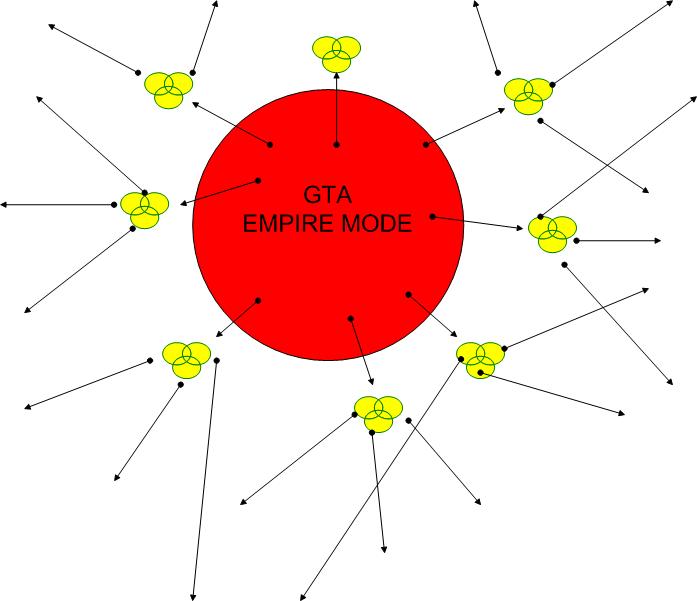
Our game addition to GTA, Empire Mode, is an attempt to get GTA out of the embedded narrative realm and into the realm of an emergent narrative. The strategic acquisition of property a la Monopoly or terroritory a la Risk, will allow for an emergent narrative. Mayham becomes strategic, as opposed to merely tactical.

Monday, March 27, 2006
Seinfeld Pilot Episode
Jerry's apartment is different. I'm looking at the walls and mouldings and I'm like - those look familiar. Then it hits me. These look like the mouldings from 27,000 Days Later. We got flats from a crew who works on TV episodes. I wonder...
UPDATE: I apologize to my readers who read Chuck's odd, gramatically challenged (if he wants to go there) comment. If I wasn't clear - I produced a USC Thesis film in which we used flats from old TV productions. I was watching Seinfeld last night, the pilot episode in which Jerry's apartment is a different set from later episodes, and recognized similar walls and mouldings. I surmised that perhaps we used the same flats from the Seinfeld pilot episode on 27,000 Days Later. This little tidbit of information made me very happy.
Jerry's apartment is different. I'm looking at the walls and mouldings and I'm like - those look familiar. Then it hits me. These look like the mouldings from 27,000 Days Later. We got flats from a crew who works on TV episodes. I wonder...
UPDATE: I apologize to my readers who read Chuck's odd, gramatically challenged (if he wants to go there) comment. If I wasn't clear - I produced a USC Thesis film in which we used flats from old TV productions. I was watching Seinfeld last night, the pilot episode in which Jerry's apartment is a different set from later episodes, and recognized similar walls and mouldings. I surmised that perhaps we used the same flats from the Seinfeld pilot episode on 27,000 Days Later. This little tidbit of information made me very happy.
Student Protests on TV
I'm struck by a couple things:
1. Why do "illegal" immigrants feel as though they have a right to be in this country? I don't think any rational person thinks we should have wide open immigration to anyone who wants to be here, much less the obligation to grant rights freely if you happen to be able to escape the border patrol.
2. At the same time contributing members of society should not be treated as second class citizens or live in fear of being deported. I realize this can be an inherent conflict with #1. But are the protests focused on this element? I tend to think it's more focused on issue #1, which doesn't seem right to me.
3. There were a lot of Mexican flags. What is this all about? I don't think it has to do with primarily identifying themselves as Mexican. I'd be willing to bet, if actually given the choice, they'd prefer to live in America and be an American any day. The Mexican flag waving is some type of idealic pride - a recognition of cultural affinity with Mexico, but not, for instance, a vote of approval for the Mexican government over the government of the US. I'm not sure. It also probably has something to do with feeling outside of the mainstream US, of not feeling assimilated, and then harkening back to some other "in-group" association that doesn't, I would say, truly exist, but acts as a sort of national surrogate for an alienated individual. I mean, isn't that what nationalism is all about anyway?
I'm struck by a couple things:
1. Why do "illegal" immigrants feel as though they have a right to be in this country? I don't think any rational person thinks we should have wide open immigration to anyone who wants to be here, much less the obligation to grant rights freely if you happen to be able to escape the border patrol.
2. At the same time contributing members of society should not be treated as second class citizens or live in fear of being deported. I realize this can be an inherent conflict with #1. But are the protests focused on this element? I tend to think it's more focused on issue #1, which doesn't seem right to me.
3. There were a lot of Mexican flags. What is this all about? I don't think it has to do with primarily identifying themselves as Mexican. I'd be willing to bet, if actually given the choice, they'd prefer to live in America and be an American any day. The Mexican flag waving is some type of idealic pride - a recognition of cultural affinity with Mexico, but not, for instance, a vote of approval for the Mexican government over the government of the US. I'm not sure. It also probably has something to do with feeling outside of the mainstream US, of not feeling assimilated, and then harkening back to some other "in-group" association that doesn't, I would say, truly exist, but acts as a sort of national surrogate for an alienated individual. I mean, isn't that what nationalism is all about anyway?
Writing
So I'm writing a spy movie. I'm having major problems. I'm 80 pages in. I like parts, but I can tell, by the feedback from my class that things aren't gelling. I guess, in a way, it's to be expected from a 1st draft. But still. It's frustrating.
And now I'm watching 24 on TV and there's this really annoying scenario...a local gas company worker is given the option of lowering the gas pressure to allow nerve gas to get distributed to 90,000 people, or have him and his friends killed. The terrorist is quite harsh and shoots anyone who objects to him...but I'm thinking - is this official really going to go along with the plan, possibly killing 90,000 people, because he's afraid the terrorist is going to shoot some more of his coworkers? I doubt it.
So I'm writing a spy movie. I'm having major problems. I'm 80 pages in. I like parts, but I can tell, by the feedback from my class that things aren't gelling. I guess, in a way, it's to be expected from a 1st draft. But still. It's frustrating.
And now I'm watching 24 on TV and there's this really annoying scenario...a local gas company worker is given the option of lowering the gas pressure to allow nerve gas to get distributed to 90,000 people, or have him and his friends killed. The terrorist is quite harsh and shoots anyone who objects to him...but I'm thinking - is this official really going to go along with the plan, possibly killing 90,000 people, because he's afraid the terrorist is going to shoot some more of his coworkers? I doubt it.
Writing Tip From Gary Ross
I wasn't at the Zaki Gordon series to hear Ross speak, but word from Phil is that he talked about the nuts and bolts of writing. Nice. He asked the audience, "How many of you have written a screenplay where the protagonist is you and he/she is too passive?" Almost everyone raised their hands. Funny.
A tip: When stuck write scenes that will NOT be in the movie. This will liberate you from the idea that a story or movie is a puzzle to be solved. It isn't. It is something to be created.
I like this idea a lot. Tomorrow, I will be doing this, writing scenes for my feature between characters that aren't designed to be in the film.
I wasn't at the Zaki Gordon series to hear Ross speak, but word from Phil is that he talked about the nuts and bolts of writing. Nice. He asked the audience, "How many of you have written a screenplay where the protagonist is you and he/she is too passive?" Almost everyone raised their hands. Funny.
A tip: When stuck write scenes that will NOT be in the movie. This will liberate you from the idea that a story or movie is a puzzle to be solved. It isn't. It is something to be created.
I like this idea a lot. Tomorrow, I will be doing this, writing scenes for my feature between characters that aren't designed to be in the film.
Order of Importance
For filmmaking, for me, right now:
1. Writing
2. Acting
3. Production Design
4. Editing
5. Framing
6. Lighting
7. Sound Design *Note: Sound is a sort of unique side category because really BAD sound trumps almost everything in that, if you cannot hear, it ruins the entire experience. That being said, really good sound cannot compensate for any missing elements.
Thoughts?
For filmmaking, for me, right now:
1. Writing
2. Acting
3. Production Design
4. Editing
5. Framing
6. Lighting
7. Sound Design *Note: Sound is a sort of unique side category because really BAD sound trumps almost everything in that, if you cannot hear, it ruins the entire experience. That being said, really good sound cannot compensate for any missing elements.
Thoughts?
Sunday, March 26, 2006
Bogdanovich
As much pleasure as I get from making fun (lame acting on Sopranos, his needy dorky love of blonde chicks, overrated as a director, etc) of Bogdanovich, I respect his love and dedication to movies. It is sad - the fact that films are becoming less and less community experiences. I don't have any ideas how to reclaim the glory of seeing pictures in the company of a large audience, when people like watching DVDs. Forcing people to the movies certainly ain't gonna happen. But it is a different experience, laughing and crying with each other. That feel of experiencing tales as a part of a community. The giddyness of when the lights go down - the closest thing I can think of to reverting back to childhood - and getting swept away in a story. That feeling you get coming out a movie that made you feel like someone else understands the human experience the way you might....
Maybe they should charge less money to see films. Maybe movies need a Walmartification - demand dominated, versus supply dominated, where mega-millions cannot be made by "event" films, therefore ceasing to produce them. It would take a bold businessman to open theaters and charge $5 a pop, $1 for popcorn, and choose movies based upon their affordability. This is the only way I can see movies reclaiming the throne of entertainment, by priviliging story over spectacle (as fun as spectacle can be). I see an initial problem in that films being made in the cheap indy sphere are probably no good - self important as cliche as Hollywood in their own quirky way. Anyhow. Something.
As much pleasure as I get from making fun (lame acting on Sopranos, his needy dorky love of blonde chicks, overrated as a director, etc) of Bogdanovich, I respect his love and dedication to movies. It is sad - the fact that films are becoming less and less community experiences. I don't have any ideas how to reclaim the glory of seeing pictures in the company of a large audience, when people like watching DVDs. Forcing people to the movies certainly ain't gonna happen. But it is a different experience, laughing and crying with each other. That feel of experiencing tales as a part of a community. The giddyness of when the lights go down - the closest thing I can think of to reverting back to childhood - and getting swept away in a story. That feeling you get coming out a movie that made you feel like someone else understands the human experience the way you might....
Maybe they should charge less money to see films. Maybe movies need a Walmartification - demand dominated, versus supply dominated, where mega-millions cannot be made by "event" films, therefore ceasing to produce them. It would take a bold businessman to open theaters and charge $5 a pop, $1 for popcorn, and choose movies based upon their affordability. This is the only way I can see movies reclaiming the throne of entertainment, by priviliging story over spectacle (as fun as spectacle can be). I see an initial problem in that films being made in the cheap indy sphere are probably no good - self important as cliche as Hollywood in their own quirky way. Anyhow. Something.
Saturday, March 25, 2006
V for Vendetta
Uhhh. So the action scenes are pretty badass. The second action sequence, in which V goes into the television station is awesome. And Tarantino says action directors are the best directors...so....
I'll stop there. I feel relieved that the great American action movie has yet to be made, so that I can one day be involved with the making of it...the New Yorker review gets the movie pretty much right.
As a note, it's become almost the easiest cliche in hollywood to make a big, bad totalitarian government into the bad guy. At one time, I suppose, it was revolutionary - like in 1950 - with the original Manchurian Candidate. But all the paranoia and supposed parallels to our current world demonstrate the basic sophistication with which teenagers might analyze US or British or Western government policies.
And what was with the bizarro anti-gay fears? This of course comes at a time when homosexuals are have more voice and rights than ever, so I'm not sure if this is supposed to be some sort of warning and to who? And sorry to be a prude, but when the hero is blowing up buildings for symbolic reasons comes pretty motherfucking close to an Al Queda endorsement, which I'm not really willing to buy into, ahora. But thank god for the closeted gay tv guy who reads the koran for poetic reasons. What would we do without him!
Oh yeah, I almost forgot, the thing that bugged me the most in the movie were the long dialog scenes. I mean - this was an action movie, right? I'm sitting there thinking - let's fuck some people up - and I'm watching V talking about Shakespeare and all this other shit to a bald Natalie Portman. Gimme a break. Make your references if you want, but do through character or situations, not cheap references that proves you read McBeth in 11th grade. Quoting Shakespeare doesn't make the film into a smart movie.
Anyhow, the films got some style and they stole the idea for the ending of our visual expression project - and they have this cool domino thing that makes no sense for the plot, but was still cool. I enjoyed watching the movie, but I wouldn't say it really has any personality, good ideas, or adds anything interesting or insightful to the world - it's just sensory fun, part time.
Uhhh. So the action scenes are pretty badass. The second action sequence, in which V goes into the television station is awesome. And Tarantino says action directors are the best directors...so....
I'll stop there. I feel relieved that the great American action movie has yet to be made, so that I can one day be involved with the making of it...the New Yorker review gets the movie pretty much right.
As a note, it's become almost the easiest cliche in hollywood to make a big, bad totalitarian government into the bad guy. At one time, I suppose, it was revolutionary - like in 1950 - with the original Manchurian Candidate. But all the paranoia and supposed parallels to our current world demonstrate the basic sophistication with which teenagers might analyze US or British or Western government policies.
And what was with the bizarro anti-gay fears? This of course comes at a time when homosexuals are have more voice and rights than ever, so I'm not sure if this is supposed to be some sort of warning and to who? And sorry to be a prude, but when the hero is blowing up buildings for symbolic reasons comes pretty motherfucking close to an Al Queda endorsement, which I'm not really willing to buy into, ahora. But thank god for the closeted gay tv guy who reads the koran for poetic reasons. What would we do without him!
Oh yeah, I almost forgot, the thing that bugged me the most in the movie were the long dialog scenes. I mean - this was an action movie, right? I'm sitting there thinking - let's fuck some people up - and I'm watching V talking about Shakespeare and all this other shit to a bald Natalie Portman. Gimme a break. Make your references if you want, but do through character or situations, not cheap references that proves you read McBeth in 11th grade. Quoting Shakespeare doesn't make the film into a smart movie.
Anyhow, the films got some style and they stole the idea for the ending of our visual expression project - and they have this cool domino thing that makes no sense for the plot, but was still cool. I enjoyed watching the movie, but I wouldn't say it really has any personality, good ideas, or adds anything interesting or insightful to the world - it's just sensory fun, part time.
Subscribe to:
Posts (Atom)